I Counted Calories for 222 Straight Days, Here’s What I Learned
How to level up your diet without tracking anything

By: Jeremy Fox CNC, CPT
Updated: November 23, 2024

You probably gleaned from the title that I’m the analytical type.
Since I got my first iPhone in 2011, I’ve been an avid user of calorie-tracking apps. So much so that I didn’t even notice this obscure streak until around day 90. It’s just part of my routine.
I realize this makes me an odd duck. Logging food is a chore for most people, and doing it every day sounds tortuously tedious.
That’s why I’m sharing what I learned from obsessively counting calories — so you don’t have to. You can apply these insights to your diet, even if you never count a single calorie.
I will also reveal the downsides of tracking calories and what I do now to allow more flexibility in my fitness routine.
Click play to watch and listen instead of read. Click HERE to subscribe to my YouTube channel and get more content like this!
Why I Started Counting Calories
Earlier this year, I set out to lose the unappealing fat in my midsection. But this wasn’t a typical crash diet to lose 10 or 15 pounds for beach season.
While counting calories works well for more aggressive weight loss, I focused on a slow and steady approach.
Here’s the “why” and the “how” of my calorie counting process.
A Specific Fitness Goal
My goal was to burn fat without starving myself or losing muscle, even if it took six months instead of six weeks.
That’s still a relatively vague target. A better goal is specific and measurable according to the SMART framework.
In my case, I aimed for gradual weight loss of 1/2 a pound per week, and I wanted all of that weight to be body fat.
A Precise Calorie Target
A goal is only as valuable as the plan to achieve it. So, the next step was establishing a calorie target that would result in my desired rate of fat loss.
To reverse engineer my goal, I started with the assumption that one pound of fat is equivalent to 3,500 calories. And a 500-calorie deficit results in one pound per week of fat loss (3,500 / 7 = 500).
By this logic, a daily deficit of 250 calories should result in half a pound of weight loss per week. It’s an oversimplification of metabolic dynamics but a decent starting point.
A Feedback Loop for Improvement
Targeting a calorie deficit of 250 calories is possible, although it requires aircraft-grade precision in your diet.
To pull it off, I needed to know my total daily energy expenditure or TDEE. Plugging my height, weight, and age into a generic TDEE calculator wouldn’t cut it.
So, I also tracked my daily calories burned using an Oura ring for everyday activity and an Apple watch for workouts.
Measuring both energy inputs and outputs allowed me to adjust my calorie intake in real time based on my actual activity level. For example:
- On an intense leg day where I burned 3,300 calories, I could eat 3,050 calories and hit my 250-calorie deficit target.
- On a laid-back rest day where I only burned 2,600 calories, I had a calorie intake budget of 2,350 calories.
In addition, I recorded my weight and body fat percentage at least a few times a week. Then, I adjusted my calorie intake if necessary to ensure continuous improvement.
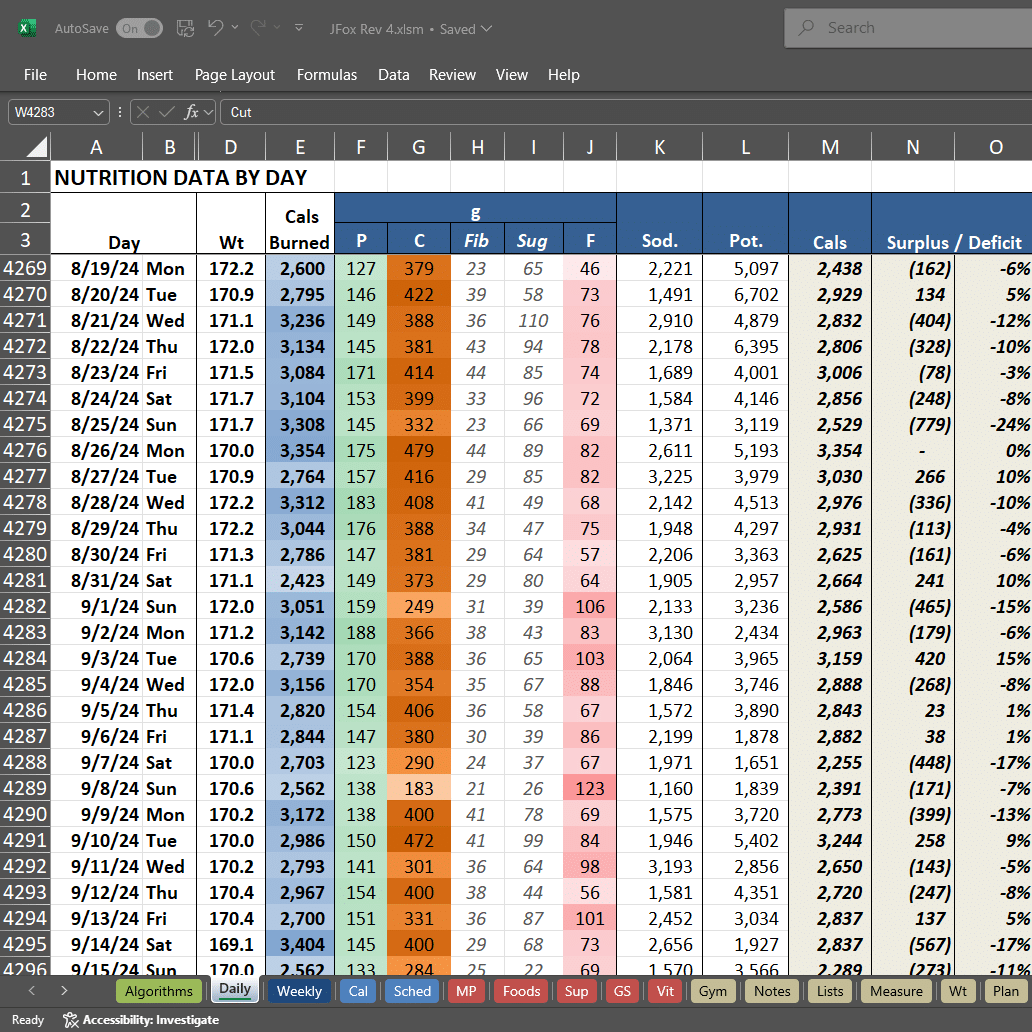
A screenshot of the spreadsheet I use to compile all my nutrition and body composition data. You can see my daily deficit fluctuates, but it averages out to close to 250 calories per day.
My Calorie Counting Results
I followed this data-driven diet every day for over half a year and documented the process with weekly check-in videos on social media.
In total, I lost 12 pounds in six months. That averages out to about 1/2 a pound a week, which was spot on my target rate of fat loss.
According to skin fold measurements, about 90% of that weight was body fat. So, I did pretty well with my goal of maintaining muscle mass.
Unfortunately, I lost a little over a pound of lean mass when I went on a week-long backpacking expedition in September (that was also the end of my calorie-tracking streak.)
Check out this short transformation video to see the results for yourself.
You can see my entire transformation and get more diet and workout tips on my YouTube channel. Click HERE to subscribe, or click on the button below!
Your results will look different if you have a significant amount of body fat to lose, and you may need to use a more aggressive calorie deficit to get the results you want.
Different situations and goals require different strategies and targets. However, calorie counting can work for almost anyone if applied correctly.
Lessons Learned From 222 Days of Calorie Counting
I don’t expect you to be this rigid in your diet. Heck, I wasn’t even expecting that level of consistency from myself!
Instead, I consider it a personal experiment — a case study with hundreds of data points and months of hands-on experience.
My job is to sift through the results and compile the information into practical tips for your daily diet routine. Here are my key findings.
1. Focus On What Matters Most
From meticulously tracking my food intake, I’ve learned that calories are the most significant factor in weight management.
a. The Physics of Energy Balance:
I remember from Thermodynamics that you cannot create or destroy energy; you can only convert it to something else. So, it’s unsurprising that energy balance is the basis of losing or gaining body mass.
To put it another way, consider your checking account’s daily deposits and withdrawals. The monthly bank statement reflects your net balance, not whether you deposit cash or checks.
Similarly, your body weight depends more on the number of calories you consume than on the ratio of carbs and fat.
b. Counting Macros vs Calories:
Many mainstream diets focus on macronutrients — such as Keto or If It Fits Your Macros (IIFYM). There’s nothing wrong with that approach if it works for you.
However, calories are often pulling the strings behind the macro curtain.
- Keto involves reducing carb intake and benefits glucose levels and insulin sensitivity, especially if you’re overweight. Cutting carbs also typically creates a calorie deficit, the primary driver of weight loss.
- IIFYM involves counting grams of carbs, protein, and fat. The thing is, each gram of these macronutrients has a designated number of calories (4 for carbs, 4 for protein, 9 for fat). Therefore, by counting macros, you’re also counting calories!
You can reach your goals as long as your macro targets align with the proper energy balance.
To prove this for myself, I ate an average of nearly 400 grams of carbohydrates daily (50–60% of calories) during this calorie-counting experiment. Even on a high-carb diet, I still lost body mass at the predicted rate because I maintained a calorie deficit.
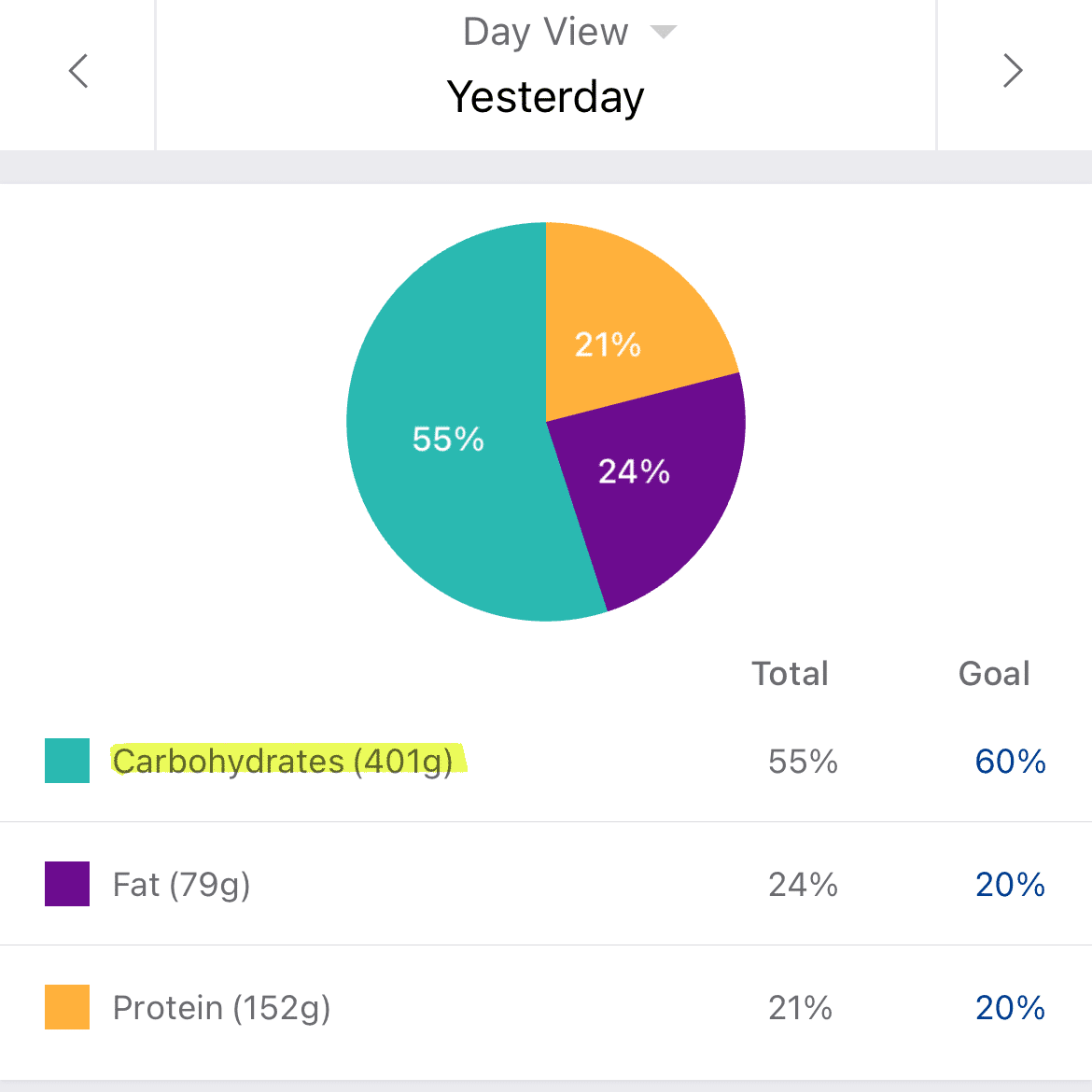
A screenshot from MyFitnessPal showing my actual macronutrient targets.
I’m not a high-carb unicorn, either. A 2020 study showed that high- and low-carb diets result in similar weight loss with a negative energy balance.
c. Keep It Simple and Flexible:
The downside of Keto is that you basically eliminate an entire food group. As a Nutrition Coach, I’ve also witnessed countless people give up on very low-carb diets after a few weeks because they didn’t allow enough flexibility.
On the other hand, macro counting provides much more flexibility with food choices. I counted macros and calories to ensure I got enough protein to maintain muscle. The problem is you have to track three numbers instead of just one.
Calorie counting only requires tracking one number. And you have the freedom to follow a high-carb diet, low-carb diet, or anything in between.
If you only have time to focus on one nutrition number, keep it simple and log your calories.
2. Intuitive Eating Doesn’t Work for Most People
By consistently counting calories, I also learned that estimating how much to eat based on a gut feeling — hunger — is often inaccurate.
People have eaten intuitively for millennia, and many people still do today without any issues. But hunger isn’t the reliable signal it once was.
- Ultra-palatable foods make consuming excess calories effortless.
- Our relationship with food is more mindless than mindful.
- If you struggle to lose weight, you’re likely eating more than you realize.
Tracking calories can decrease the disconnect between eating and energy balance.
For me, an active lifestyle and a relatively fast metabolism combine forces to keep me skinny. Even when I feel like I’m eating a lot, it’s usually not enough to maintain my body weight.
Tracking calories helps me ensure I’m eating enough to burn fat without losing hard-earned lean mass.
As an engineer, I appreciate the saying, “You cannot control what you don’t measure.”
In this regard, tracking calories is a quantitative solution to the intuitive eating problem.
3. Accountability Builds Good Habits
When I started tracking calories consistently, I noticed my eating habits changed. I ate less at restaurants and made more meals at home simply because I knew what was in the food I prepared.
During this process, my wife became more interested in nutrition and even started tracking her calories with me. After several weeks, she lost 7 pounds and was hooked on healthy eating.
Now that we’re expecting our first child, counting calories isn’t a priority. Nevertheless, she still focuses on minimally processed foods because of the positive habits developed from tracking calories.

My wife made these delicious healthy subs for lunch.
The Dark Side of Counting Calories
Despite their helpful insights, fitness trackers and calorie-counting apps have limitations and downsides.
- Accuracy Issues: Tracking calories is only effective if you have accurate numbers. It starts with knowing how many calories you burn. TDEE calculators and fitness trackers only estimate calorie expenditure based on your body mass, activity level, heart rate, etc. Additionally, calorie-counting apps rely on the accuracy of nutrition labels and having specific foods in the database. The calorie inputs could be off if you use a different food or don’t measure your portions. A slight inaccuracy is fine. But being off by a couple hundred calories can be the difference between a plateau and progress.
- Time Commitment: Measuring portions, checking nutrition labels, and logging foods in an app can take up to 20 minutes each day. I realize many people can’t find the time to do this or justify making the time. I’ve gotten it down to less than 5 minutes a day with familiarity with the app and repetition. Nevertheless, that adds up to 15 hours invested over 6 months.
- Analysis Paralysis: The more data you have, the more time you spend looking at it and deciding what to do next. I have this problem with everything from marketing budgets to calorie tracking. Often, the time sucked into analyzing data is better spent taking action. If you have the choice between counting calories or exercising for 20 minutes, you should probably do the latter!
Balancing Life and Calories
Throughout this process, I gained valuable insights and continue counting calories today. However, I’ve also learned that energy balance doesn’t just apply to calorie intake.
Now, I’m more focused on balancing stress levels and living meaningfully. If that means taking a break from counting calories for a day, week, or month — so be it.
I’ve also realized our bodies don’t care about how much we ate yesterday or today. It reacts to cumulative changes in energy balance over days or weeks.
So there’s no reason we should stress out about every calorie either.
What matters more is that you’re eating healthy for the long run. Whatever diet or eating strategy helps you do that is right for you.
Take Control Of Your Diet
If the idea of counting and tracking things doesn’t appeal to you, that’s okay. You can still take control of your diet by paying more attention to nutrition labels and food choices, even if you don’t count anything.
On the other hand, if you are a numbers person like me, the bar code scanners and voice logging features on current apps can log your entire day’s food in minutes.
I use the MyFitnessPal app because it’s what I know. All my regular foods are stored on it, which makes logging meals easier.
My wife likes the MyNetDiary app because it provides a food grade for everything you eat. This insight alone can be a game changer in making better nutrition choices.
At the very least, quantifying your everyday eating habits will help you see if you’re eating more or less than you thought.
Just one week of paying attention to what you eat can be enough to change your relationship with food — and that’s the real power of counting calories.
I’m a NASM-certified nutrition coach specializing in body transformations. I provide personalized nutrition plans with recipes formulated to fit your macros — so you never have to count or track anything!
>>Click here to get your custom nutrition plan with no counting required.