Floor Press vs Bench Press Guide
Differences In Exercise Technique & Muscles Worked
By: Jeremy Fox, CNC, CPT – Published: September 29, 2023
Has your strength level on the bench press exercise hit a plateau? Or do you struggle to lock out at the end of your bench? Then, the floor press could be a game-changing auxiliary lift to add to your chest training routine.
Although the floor press is very similar to the bench press, it differs greatly in execution and training outcome. This post will delve into the pros and cons of both exercises, as well as their ideal applications.
Whether you are a seasoned powerlifter or a gym newbie, knowing the differences between these two exercises can help you improve your workouts and reach your strength goals faster.

What Is a Floor Press?
The floor press is an effective strength training exercise involving lying flat on the floor while pressing a barbell or dumbbell. You lower the weight like a traditional bench press, but the movement stops when the back of your upper arms touch the floor.
This exercise is ideal for improving upper body strength and stability without the need for a flat or adjustable bench. It also targets the muscle groups of the upper body differently than the bench press.
Floor Press Muscles Worked
When performing the floor press, you target the same muscles as the bench press, including the pectorals, anterior deltoids, and triceps. However, the floor press tends to put slightly more emphasis on the triceps than the traditional bench press.
Additionally, the floor press reduces or eliminates support from the lower body, which is often used to generate more power during a bench press.

Floor Press vs. Bench Press Differences
It’s important to understand the differences between the floor press and bench press in order to use them effectively and avoid injury. In this section, I’ll walk you through the differences in setup, range of motion, and execution.
Setup for Floor Press vs. Bench Press
First, positioning your body before the exercise is critical in both the floor press and bench press to ensure safety and stability.
With the floor press, you lie flat on the floor with a slight arch in your back. You can bend your legs and place your feet on the floor, but I recommend putting your legs straight out to avoid lifting your butt while pressing.
By comparison, the bench press typically involves a more pronounced back arch while pulling your shoulder blades down to stabilize the shoulder joint. And most often, your feet are planted firmly on the floor.
The grip on the barbell or dumbbell is the same for both exercises.
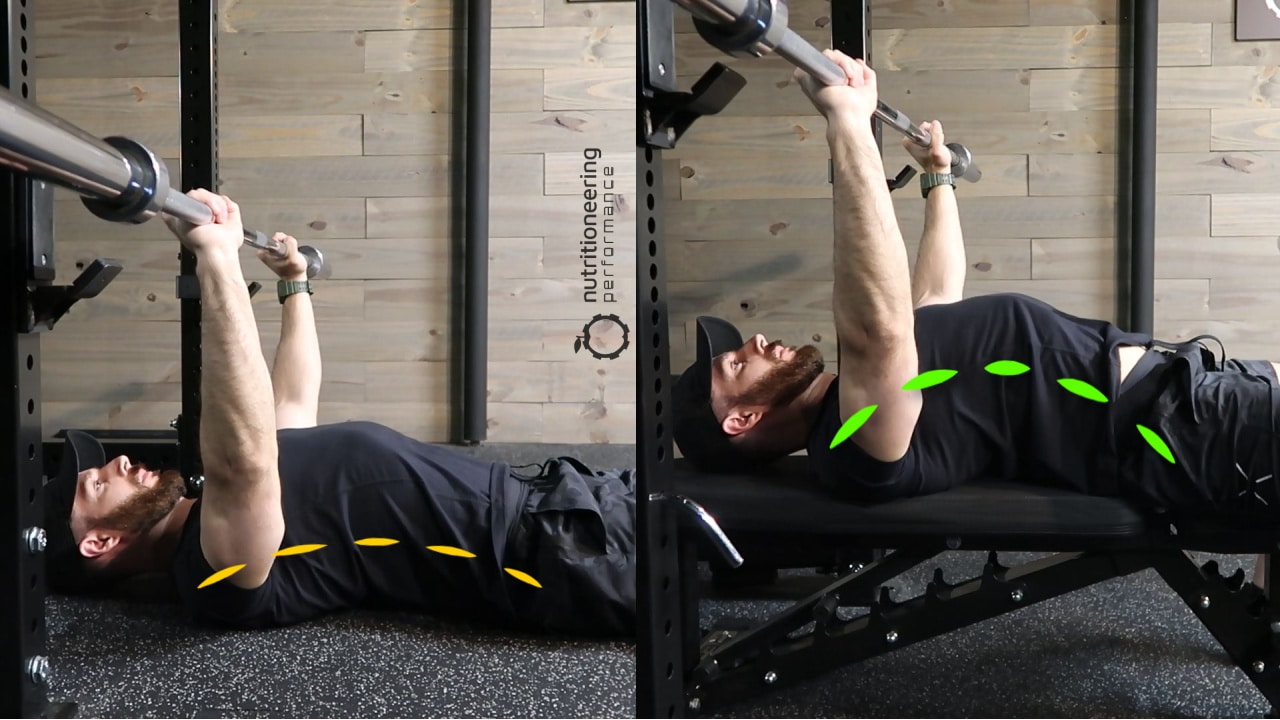
Notice how my back is still arched on the floor press, although to a lesser extent due to my legs being straight.
Floor Press vs Bench Press Range of Motion
The main difference between the floor press and the bench press execution is the range of motion, which is shorter with the floor press compared to the bench press.
As you lower the weight during the floor press, the back of your upper arms will make contact with the floor and stop the movement when the bar is still a few inches away from your chest.
On the other hand, the traditional bench press involves lowering the bar all the way to your chest, resulting in a deeper stretch in the chest and front of the shoulders. Sort of like a conventional deadlift vs rack pull.
Your individual range of motion on either exercise will depend on your chest thickness, arm length, grip width, and how much arch you use.
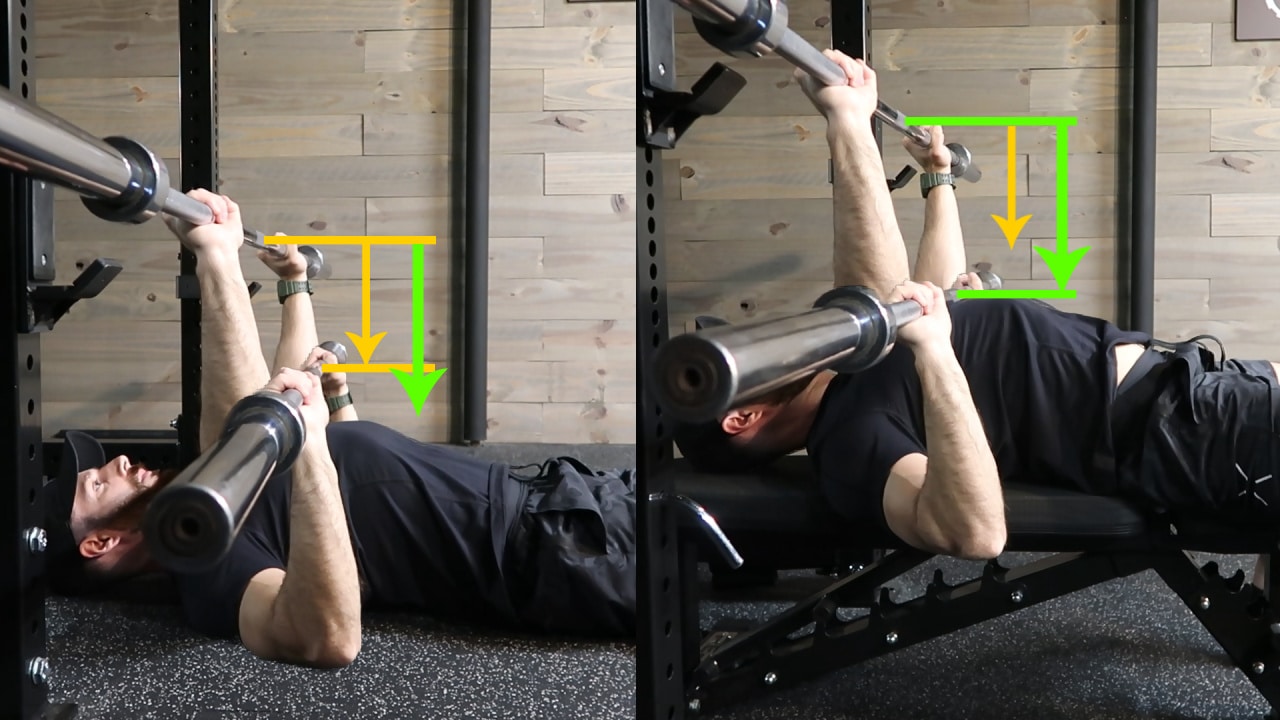
The green and yellow arrows show the different magnitudes in the range of motion between the floor press vs bench press.
Floor Press vs Bench Press Kinematics
Another key distinction between the floor press and the traditional bench press is the movement speed and the force generated by your muscles during the lift, also called kinematics.
For example, the weight should completely stop at the bottom of the floor press. The dead stop during the floor press demands overcoming zero momentum.
Comparatively, the bar often sinks into your chest slightly during a bench press, which triggers the muscle stretch reflex and helps spring the weight back up like the tension in a tight rubber band.
Essentially, your muscles must generate more power to get the bar moving again in the floor press. This is similar to the concept involved in box squats for your lower body.
My YouTube channel has dozens of videos showing you how to do a variety of bodybuilding exercises. You’ll learn how to target and build specific muscle groups in 90 seconds or less. Click HERE to subscribe, or click on the button below!
When to Use Floor Press vs Bench Press
The standard bench press should remain a consistent part of your upper body workout routine. But there are a few instances where the floor press makes a terrific addition or alternative.
First, the best time to use the floor press is when you have a sticking point during a heavy bench press. This occurs when you can initiate the movement but fail to lift the bar more than a few inches off your chest.
Another example of when the floor press can be advantageous is if you struggle to lock out at the top of heavy bench press reps. In this case, you can complete 80-90% of the lift but get stuck before your arms are fully extended.
A third, albeit less common, application of the floor press is when you have a shoulder issue that becomes aggravated in the stretched position at the bottom of a full range of motion bench press. Of course, you should consult with a physician if you have an injury.
Finally, the floor press is an excellent alternative to the bench press if you don’t have a bench available. This could be the case if you have a small home gym or if all the benches are taken in a busy commercial gym.
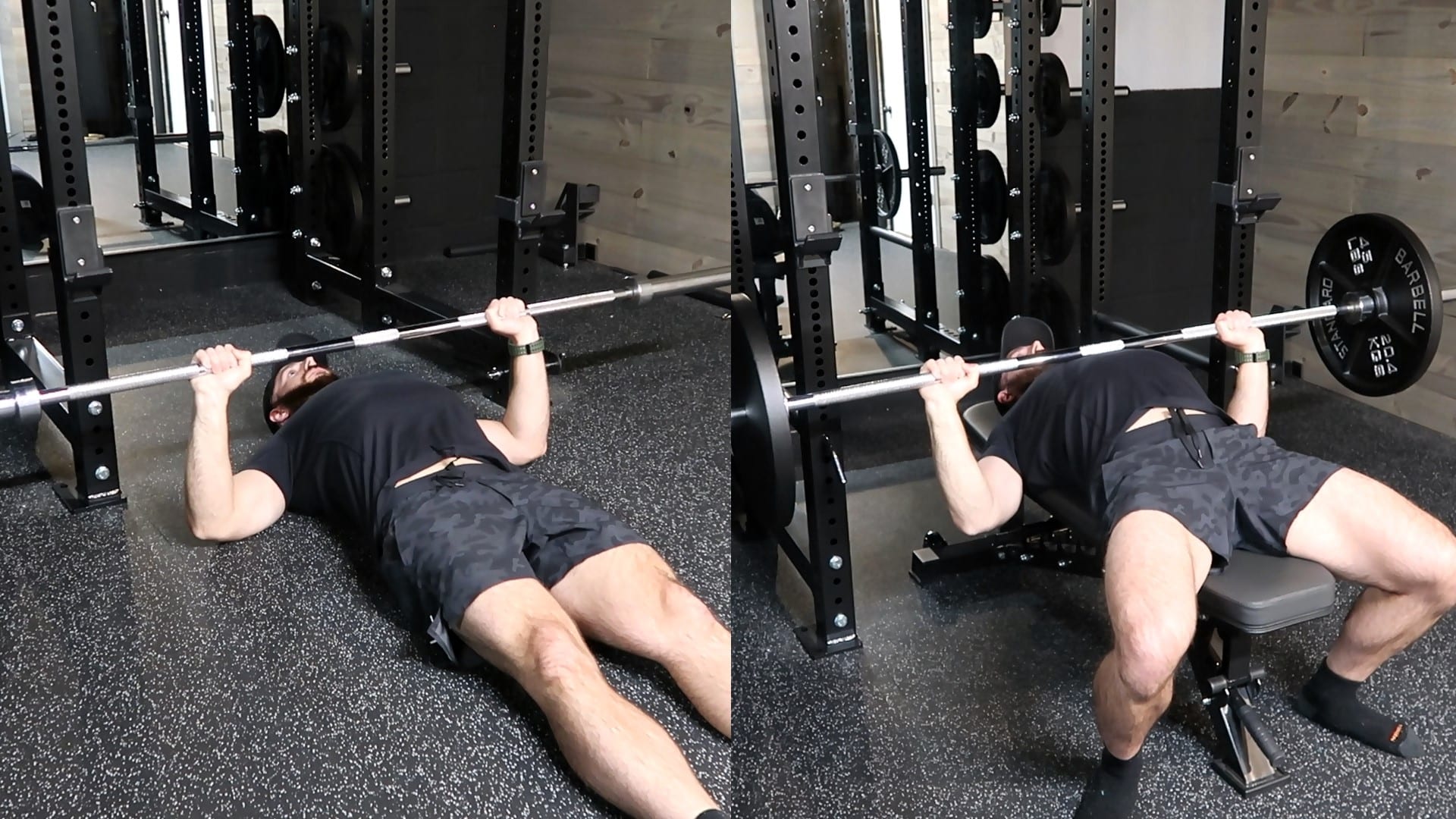
The floor press is best used as a supplemental lift along with the bench press to increase overall upper body strength.
Floor Press FAQ
After discussing the differences between the floor press and bench press, let me address some common questions you may have.
Is the floor press harder than the bench press?
You will probably find the floor press is more challenging than a regular bench press due to the requirement to control the eccentric more and come to a dead stop at the bottom. But the fact that it’s more difficult is one of the reasons it’s effective!
What percentage of bench press is floor press?
Initially, your floor press weight will likely be 75-80% of your bench press weight as you get used to the dead stop. However, on average, experienced lifters can floor press about the same weight they can bench press, according to strengthlevel.com standards.
Can you build chest muscle with the floor press?
The floor press is less effective for maximum chest growth due to the shorter range of motion than the bench press. However, it can be an excellent tool to increase your bench press strength, leading to more hypertrophy in the long run.
Custom Nutrition & Workout Plan
Get a personalized meal plan built to fit your body and lifestyle. Including a custom workout routine designed around your fitness goals.
With your custom plan, you will finally be able to burn fat, build muscle, and transform your body. All this for just $19.99!
Click here to choose your plan.
More Chest & Tricep Exercises
The floor press and bench press are two hugely effective upper body movements, especially when used together as part of a strength-building strategy. But a complete chest workout should still include several other exercises.
So here are some additional articles that should help you design your ultimate upper body training routine.
Incline Bench Press vs Flat Bench Press For Building Chest
Best Barbell Tricep Exercises With Example Workout
21 Cable Chest Exercises for Upper, Lower, & Mid Pec Workout
Best Skull Crusher Alternative Exercises for Huge Triceps
13 Best Medial Head Tricep Exercises According to Physiology

Based on the information provided, you have a solid foundation for achieving your goals of building a stronger upper body. If you found this article helpful, I believe you may also find these additional resources to be valuable.

3 Cable Triceps Pressdown Mistakes & How To Fix Them For Bigger Arms
Stop doing this on the triceps pressdown! Learn the proper technique so you can start building sleeve-busting arms in your next workout.

15 Compound Shoulder Exercises for Strength & Size
Compound movements are king for muscle size and strength. Here are the 15 best compound shoulder exercises for blasting delts.

13 Dumbbell Lat Exercises to Beef Up Your Back Workout
Most people only know a few dumbbell exercises for lats. Shock your back into growth with these 13 dumbbell lat exercises.

Press Up vs Push Up Exercises For Building Your Chest
What is the difference between a press-up vs push-up? See the best press up variations for building your chest and strengthening your core.

DMHA Pre-Workout Status, Availability, and FAQ
DMHA pre-workout supplements contain a powerful stimulant & fat burner. Here are the brands that still have DMHA.

Jason Statham Height, Weight, & Body Composition
Jason Statham's height and weight compared to other famous people. Plus, how he maintains a shredded physique.

11 Essential Lower Back Barbell Exercises for Pain Prevention
Prevent pain and injury with these lower back barbell exercises, including modified rows and deadlift alternatives.


