Standing Lateral Raise Exercise Guide
By: Jeremy Fox, CNC, CPT – Published: December 5, 2023
The dumbbell standing lateral raise is an extremely effective exercise to strengthen and widen your shoulders with minimal equipment. This exercise is better for isolating your shoulders than pressing movements and can help you achieve the size and shape you want.
Watch this 1-minute exercise tutorial video or keep reading for a more detailed guide.
In this blog post, I will explain how to perform the standing lateral raise correctly and provide some tips on how to maximize the benefits of this exercise. Whether you are a beginner or an experienced weightlifter, performing this exercise correctly can help you achieve better shoulder gains!
Feel free to use the table of contents below to jump to the section with the information you’re looking for.
What Is A Lateral Raise?
A lateral raise is a strength training exercise that primarily works the shoulder muscles. It involves raising the arms out to the sides, with the elbows slightly bent, until they are at shoulder level.
This exercise can be done with dumbbells, resistance bands, or machines. It can also be performed in the standing or seated position.
Lateral Raise Muscles Worked
The standing lateral raise is a single-joint isolation exercise that primarily works the shoulder muscles. In particular, it targets the lateral or side deltoid, which is in the middle of your shoulder.
However, the lateral raise also involves the anterior or front delt and the posterior or rear delt to varying degrees. The extent to which each deltoid muscle is worked depends on the technique used for the exercise, which I will explain in detail.

Standing Lateral Raise Benefits & Limitations
The most significant benefit of the standing lateral raise compared to seated variations is that you don’t need a bench. The only equipment needed for this exercise is a pair of dumbbells.
Another benefit is playing with different variations by bringing the dumbbells to the front or leaning your body while performing the exercise. However, it’s also easier to cheat and use momentum with the standing vs seated lateral raise.
Pros
- You don’t need a bench to sit on.
- Multiple exercise variations in the standing position.
Cons
- You are more likely to cheat with momentum.
How To Do Standing Lateral Raises
Here are the basic steps to perform the dumbbell standing lateral raise correctly.
- Start by holding a dumbbell in each hand and standing with your arms straight down by your sides. Plant your feet firmly on the floor, engage your core, and keep your chest up and shoulders back.
- Slowly lift the dumbbells simultaneously to the sides, away from your body. As you lift, keep your arms slightly bent at the elbows.
- Continue raising the dumbbells until your arms are at shoulder level or slightly above it. Avoid lifting higher, as this is the point where the trapezius muscles take over.
- Hold the position at the top briefly, focusing on squeezing your lateral deltoids.
- Slowly lower the dumbbells back to the starting position, not letting them drop or swing. Maintain control throughout the exercise.
- Perform the desired number of repetitions. A typical set may consist of 8-12 reps, but you can adjust this based on your fitness level and goals.

Standing Lateral Raise Form
The description and video above should give you a great starting point for performing the standing lateral raise effectively. But here are some additional tips to help you master perfect form.
- Arm Position – Your arms should typically be slightly bent during the lateral raise. But you can also perform this exercise with your arms bent at 90-degrees if that helps you contract your side delts.
- Hand Position – To maximize side delt activation, it helps to rotate your hand so your thumb tilts slightly down at the top of the movement. Picture yourself pouring out a bottle of water.
- Visualization – It can also be helpful to think about pushing your elbows up toward the ceiling instead of your hands because your upper arm is directly connected to the deltoid muscles.
Standing Lateral Raise Variations
You can do some standing lateral raise variations with different equipment or body positions. Here are a couple of examples.
1. Cable Lateral Raise
This exercise uses a low cable with a single handle attachment while performing the standing lateral raise. One benefit of this variation is that the cable provides more constant tension throughout the range of motion.
Specifically, you will feel more resistance at the bottom of the movement with the cable than with the dumbbell. This makes it an excellent alternative for maximizing side delt activation, but you must have a cable apparatus.
2. Leaning Lateral Raise
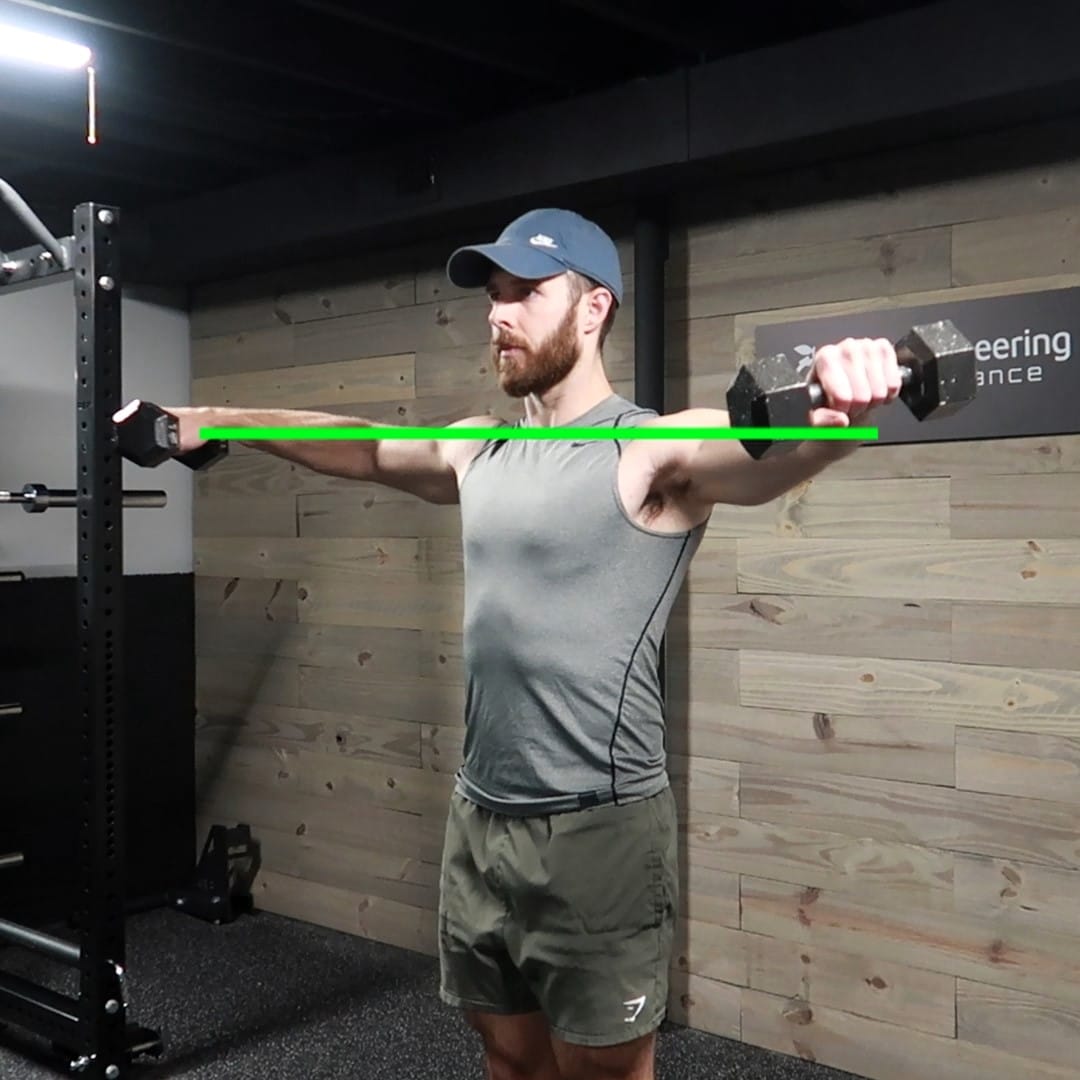
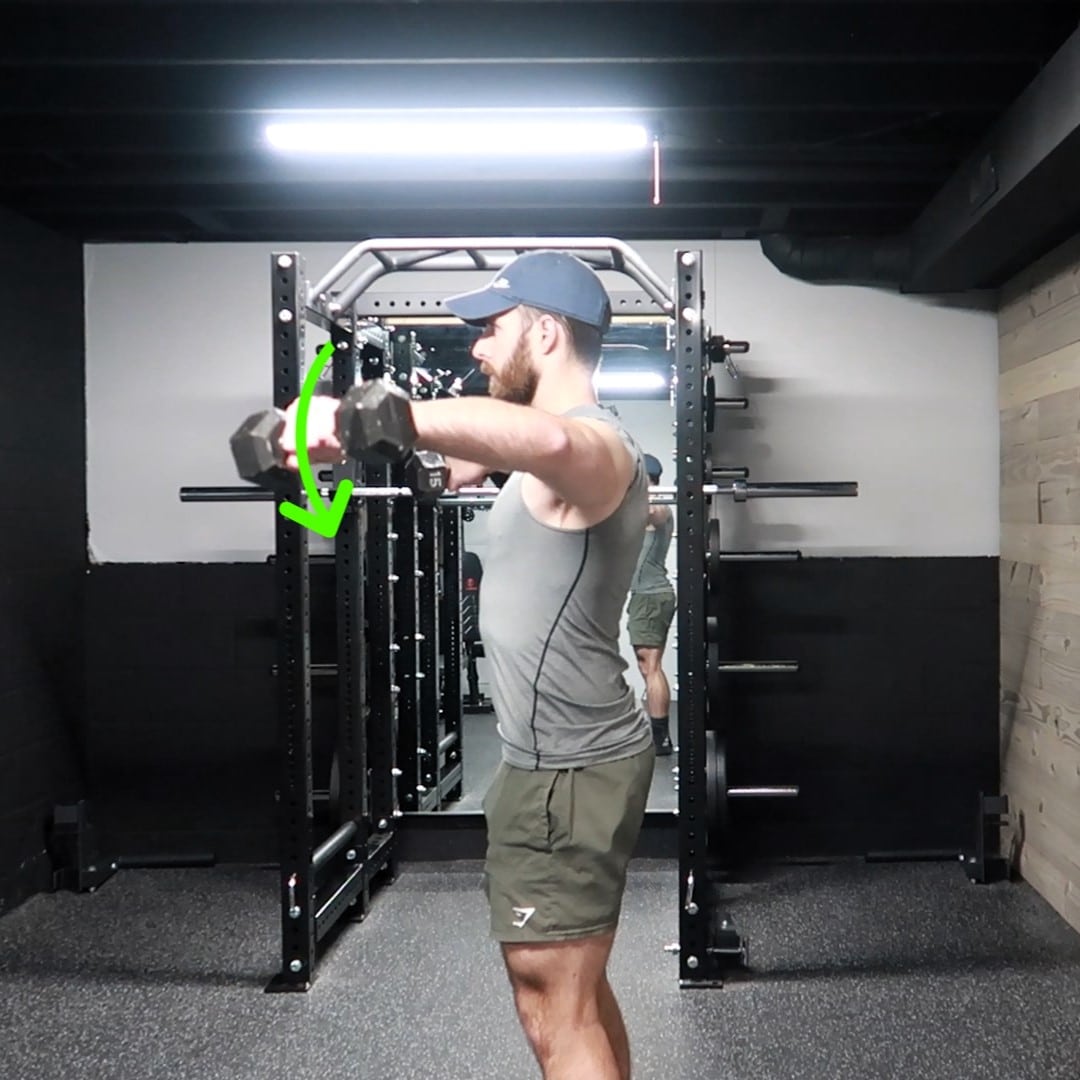
Another standing lateral raise variation involves leaning to one side while performing a single-arm side raise. You can achieve this by holding a machine frame or power rack with one arm and leaning away at a slight angle.
You perform a one-arm lateral raise with your free hand from this position. When performed with a cable, the leaning lateral raise effectively increases the range of motion.
However, when done with a dumbbell, as shown below, the range of motion is actually shorter. Still, the leaning lateral raise can be an effective variation for working the side delts differently.

Standing Lateral Raise Alternatives
Here are some of the best seated lateral raise alternative exercises to change things up and add variety to your shoulder training routine.
1. Seated Lateral Raise
The seated lateral raise is an excellent alternative to the seated lateral raise. The exercise is exactly the same, except you sit on a bench while doing it. This position reduces momentum and makes it easier to isolate the side delts.
My YouTube channel has dozens of videos showing you how to do a variety of bodybuilding exercises. You’ll learn how to target and build specific muscle groups in 90 seconds or less. Click HERE to subscribe, or click on the button below!
2. Machine Seated Lateral Raise
The machine lateral raise is another seated exercise that usually also provides chest or back support. Additionally, the machine maintains constant tension on your delts, where free weights lose tension at the bottom of the lateral raise.
3. Kneeling Landmine Lateral Raise
The kneeling landmine lateral raise involves holding one end of a barbell while the other end is secured in a pivoting base. This exercise reduces momentum like the seated lateral raise but doesn’t require a bench to sit on.
Related: 9 Best Landmine Shoulder Exercises
Custom Nutrition & Workout Plan
Get a personalized meal plan built to fit your body and lifestyle. Including a custom workout routine designed around your fitness goals.
With your custom plan, you will finally be able to burn fat, build muscle, and transform your body. All this for just $19.99!
Click here to choose your plan.
More Shoulder Exercises & Workouts
The seated lateral raise is an effective exercise for isolating and building the side delts. But a complete shoulder workout should still include some compound movements like shoulder presses.
So here are some additional articles that should help you design your ultimate shoulder training routine.
Seated Military Press Benefits, Muscles Worked, & Variations
How To Do The Plate Front Raise for Bigger Shoulders
Seated Dumbbell Shoulder Press – How to Fix Your Form
Push Press vs Overhead Press Muscle Activation & Power Output
Arnold Press vs Shoulder Press for Size and Strength Gains
11 Best Dumbbell Shoulder Exercises With Example Workout
Best Lateral Deltoid Exercises for Broader Shoulders (+Workout)

Based on the information provided, you have a solid foundation for achieving your goals of building bigger, broader shoulders. If you found this article helpful, I believe you may also find these additional resources to be valuable.

Young Ronnie Coleman Natural Before Steroids
Was Ronnie Coleman natural in the early 90s? I looked at his entire career to determine when the 8x Mr. Olympia started taking steroids.

Average Neck Size Statistics and Charts for Men & Women
Your neck can tell a lot about your health and fitness. See the average neck size for men & women with percentiles and visual charts.

High-Intensity Resistance Training (HIRT) for Muscle Gain
Stop wasting time on junk volume. Learn how to use high-intensity resistance training to build more muscle in less time.

Study Reveals Average Bodybuilder Height Since 1965
Have you ever wondered what the ideal height is for bodybuilding. I compiled height data for 60 years of Mr. Olympia winners to find out.

Dirty Bulk vs Clean Bulk Meaning, Foods, Results, & More
Learn the difference between a dirty bulk and a clean bulk. Plus see the pros and cons with actual dirty bulk results.

6 oz Chicken Breast Protein – Skinless/Skin, Raw/Cooked, Bone-In/Out
A typical 6 oz chicken breast has about 40 grams of protein. But this varies with type and brand. Read more to compare protein content!

Dr Mike Israetel Height, Weight, & Training Principles
Learn about Dr. Mike Israetel's height, weight, and hypertrophy training program. How he grew his YouTube channel and his physique.


